

Introduction: Why Material Accuracy Matters in Food Packaging
Food packaging manufacturers operate under constant pressure from three directions: cost control, food safety compliance, and sustainability requirements. Whether producing thermoformed meal trays or thin-wall injection molded cups, even small deviations in material ratios can lead to unstable quality, higher scrap rates, and inconsistent product performance.
This is why gravimetric blenders have become a standard auxiliary machine in modern food packaging plants. Unlike volumetric dosing, gravimetric blending measures materials by actual weight, ensuring precise formulation control even when bulk density, moisture, or regrind ratios fluctuate.
Core Application Areas in the Food Packaging Industry
1. Thermoforming: Meal Trays, Cups, and Food Containers
Thermoforming lines typically process sheet materials that are later formed into food trays, bowls, or cups. These sheets often require multi-material blending, commonly including:
Virgin polymer (PP, PET, PS, or PC)
PCR (post-consumer recycled material)
Production regrind
Color masterbatch or functional additives
In real production environments, material ratios are rarely static. Manufacturers may adjust PCR content daily based on availability, regulatory targets, or customer requirements. A gravimetric blender allows operators to change recipes digitally without mechanical recalibration, maintaining stable sheet quality across shifts.
2. Thin-Wall Injection Molding: High-Speed, High-Precision Production
Thin-wall injection molding for food packaging runs at extremely high cycle speeds. Any inconsistency in melt flow or material composition can immediately result in:
Short shots
Warpage
Poor surface finish
Increased reject rates
Gravimetric blenders installed at the machine throat ensure consistent feeding accuracy, even when regrind ratios change. This is particularly critical for thin-wall products where wall thickness tolerance is minimal.
Typical Material Configurations in Food Packaging
Food packaging applications often require 2–4 material components, depending on product design and regulatory requirements:
Base resin: Virgin PP, PET, PS, or PC
PCR material: Controlled percentage to meet sustainability goals
Regrind: Inline recycling from trimming or rejected parts
Additives: Color masterbatch, antiblock, or barrier-enhancing agents
A gravimetric blender enables each component to be metered independently, allowing precise control over final material composition without relying on operator experience.
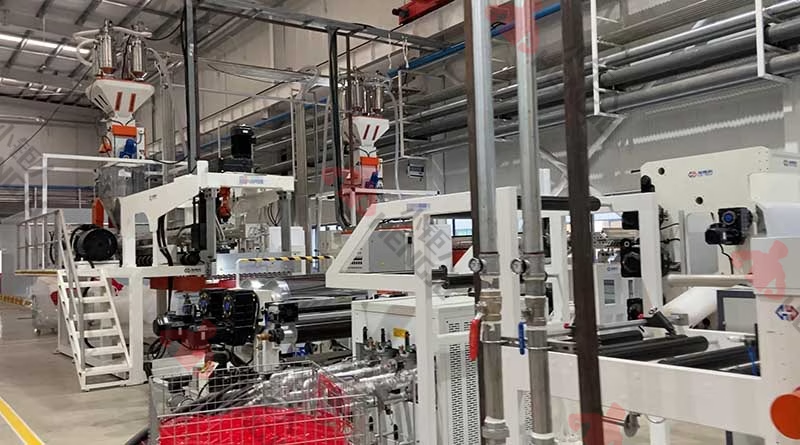
Case Insight: Thermoforming Food Containers in Thailand
One of our customers in Thailand specializes in thermoformed meal containers for the local food service market. Their production uses a PC / PCR material blend, where recycled content must remain stable to ensure both food safety compliance and mechanical strength.
Before adopting gravimetric blending, they experienced:
Fluctuating PCR ratios
Sheet thickness inconsistency
High setup time when changing recipes
After installing a gravimetric blender, the customer achieved:
Stable PCR percentage across long production runs
Faster recipe changeovers
Reduced material waste during startup
This case highlights how gravimetric blending directly supports both production efficiency and sustainability objectives in food packaging.
Machine Configuration: Central vs. Machine-Side Blending
Machine-Side Installation for Space Efficiency
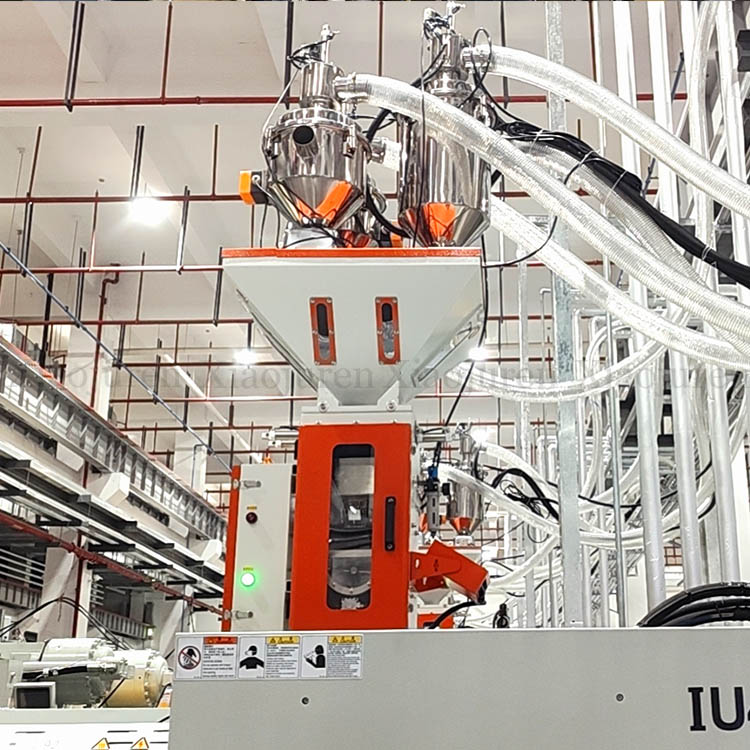
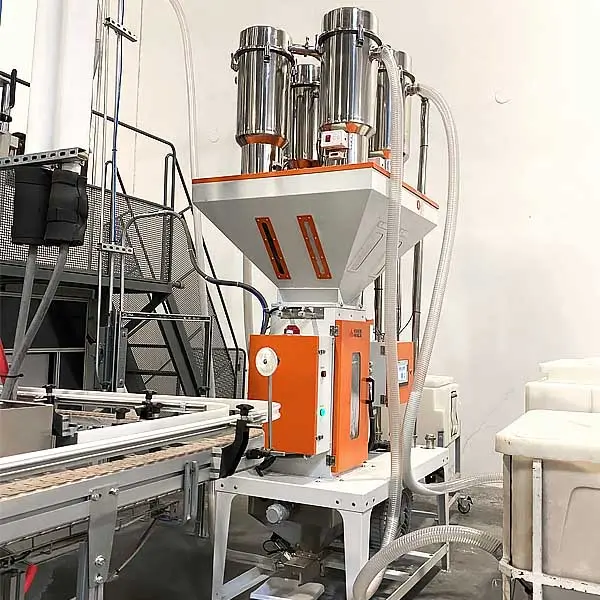
In many food packaging plants, floor space is limited. A common configuration is a two-in-one solution, combining:
Vacuum loader
Gravimetric blender
Installed directly beside or on top of the processing machine, this setup minimizes material travel distance and simplifies installation.
Inline Regrind Utilization
For thin-wall injection molding and thermoforming lines, edge trim and rejected parts can be crushed inline. The regrind is then fed directly back into the gravimetric blender, allowing immediate reuse without intermediate storage. This closed-loop approach significantly reduces raw material costs.
Why Gravimetric Blending Outperforms Volumetric Systems
| Aspect | Volumetric Feeding | Gravimetric Blending |
|---|---|---|
| Measurement basis | Volume | Actual weight |
| Sensitivity to density changes | High | Minimal |
| Recipe repeatability | Limited | High |
| PCR / regrind control | Inaccurate | Precise |
| Suitability for food packaging | Medium | High |
For food packaging manufacturers pursuing consistent quality and regulatory compliance, gravimetric systems provide a clear technical advantage.
Compliance, Traceability, and Process Stability
Food packaging often requires documentation of material composition, especially when PCR content is involved. Gravimetric blenders support:
Digital recipe storage
Batch-level material tracking
Stable, repeatable formulations
These features simplify internal quality audits and customer compliance checks.
Typical Throughput Range in Food Packaging Applications
Most food packaging gravimetric blending systems operate within:
Throughput: 500–1200 kg/hr
Material ratio range: 5%–100% per component
Accuracy: ±0.5% (depending on model and configuration)
This range comfortably covers the majority of thermoforming and thin-wall injection molding lines.
Conclusion: A Key Enabler for Modern Food Packaging
As food packaging moves toward lighter designs, higher PCR content, and stricter quality control, gravimetric blenders are no longer optional equipment. They are a core process tool that connects material cost control, sustainability goals, and production stability into one system.
For manufacturers of food trays, cups, and thin-wall containers, gravimetric blending provides the precision needed to remain competitive in a rapidly evolving market.
Typical Gravimetric Blender Products for Food Packaging
Below are common gravimetric blender configurations used in food packaging plants:
2-component gravimetric blender
Virgin material + PCR or regrind
Ideal for basic thin-wall injection molding
3-component gravimetric blender
Virgin resin + PCR + color masterbatch
Widely used in thermoforming sheet lines
4-component gravimetric blender
Virgin resin + PCR + regrind + additives
Suitable for complex food packaging formulations
Vacuum loader + gravimetric blender integrated unit
Space-saving, machine-side installation
Common in high-speed injection molding lines